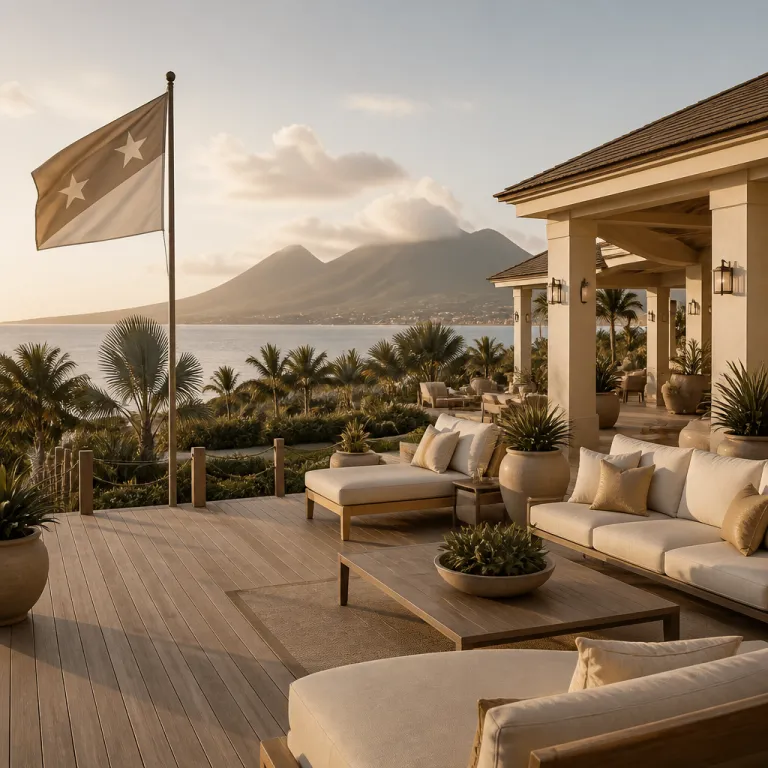
St Kitts flag as a compass for luxury island getaways
The St Kitts flag is more than a national emblem for travellers. It quietly guides how refined hotels on the islands curate experiences that feel rooted in place and culture. When you choose a luxury stay in Saint Kitts or Nevis, you are also choosing how closely your trip aligns with the values woven into that national flag.
According to the Government of Saint Kitts and Nevis, green on the flag represents fertile land, red honours the struggle for freedom, black signifies African heritage, yellow stands for year-round sunshine, and the two white stars symbolise hope and liberty for the twin-island federation. High-end resorts translate this symbolism into garden suites overlooking lush hillsides and former plantations, curated excursions to Independence Square in Basseterre and the National Museum, and cultural programming that highlights African-Caribbean heritage through art collections, live music evenings, and tasting menus inspired by West Indies culinary traditions.
Yellow on the St Kitts flag inspires expansive ocean-facing pools and shaded cabanas that frame the Caribbean light, while the twin white stars are echoed in the dual character of Saint Kitts and Nevis and in the sense of space you feel in large suites and private villas. As one concierge at a leading Basseterre hotel explained in a 2023 interview for a local tourism newsletter, “We fly the flag to remind guests that every view, every plate, every story comes from this federation.” When you see the flag waving above a resort entrance, it signals a Saint Kitts and Nevis property that is consciously part of the wider national story.
From colonial symbols to the modern national flag over five star resorts
Before independence, the islands flew British colonial flags that reflected external rule rather than local identity. Today the modern design of the St Kitts and Nevis flag, created by student Edrice Lewis in a national competition documented by the Government of Saint Kitts and Nevis, flies above luxury hotels as a statement of self-confidence and cultural pride. That shift from a British colonial ensign to a bold national flag changed how high-end hospitality presents Saint Kitts and Nevis to discerning guests.
The diagonal black band and bright colours now appear in subtle ways across premium properties, from flag images in lobby artwork to flag vector motifs on in-room stationery. Some resorts commission custom textiles and ceramics that echo the St Kitts flag palette without feeling like souvenir stock or generic flag stock décor. This careful use of national colours creates a refined background that feels authentic rather than themed.
When you browse a luxury and premium hotel booking website focused on these islands, look for images that show the national flag respectfully integrated into architecture or landscape. Properties that feature the Nevis flag or the combined Nevis–Kitts identity often also invest in staff training about local history and culture. For a deeper sense of place, consult a specialist guide to luxury stays in Saint Kitts and Nevis, which highlights hotels where the federation flag story is part of the guest experience.
Reading the colours of the St Kitts flag when choosing your hotel
Understanding the symbolism of the St Kitts flag helps you read between the lines of hotel descriptions. Official explanations summarise it as: “Green symbolizes fertile land; red represents the struggle for freedom; black signifies African heritage; yellow denotes sunshine; white stars stand for hope and liberty.” When a property references these themes, it often signals a more thoughtful approach to luxury.
Green can guide you toward island retreats with strong sustainability programmes, from solar-powered villas to kitchen gardens supplying fine dining menus. Red, linked to the struggle for freedom, often appears in curated heritage tours that take you beyond standard Caribbean beach clichés. Black, representing African heritage, may be reflected in partnerships with local artists whose work you might first see as flag images or abstract flag vector patterns in public spaces.
Yellow, the colour of sunshine, is a reminder to check how a resort uses natural light in suites and shared areas, not just in marketing images. The white stars of the national flag echo the twin-island layout of Saint Kitts and Nevis, so consider splitting your stay between both islands for a richer sense of the federation. For an all-inclusive approach that respects this dual identity, consult an expert planner through a guide to a refined all inclusive escape in Saint Kitts.
Where the flag flies: mapping luxury stays across the federation
The St Kitts and Nevis flag was officially adopted on Independence Day, 19 September 1983, and its first formal raising in Basseterre marked a new chapter for hospitality. Today, the national flag flies over Government Headquarters in Basseterre and over many five star resorts along the coasts. When you plan your trip, it helps to think in terms of a flag map that links key luxury zones to the symbolism of the federation.
On Saint Kitts, the South East Peninsula offers secluded coves where the flag waving above a resort entrance contrasts with the deep blue Caribbean Sea. These properties often provide private transfers from Robert L. Bradshaw International Airport, with the St Kitts colours discreetly present on vehicle livery or staff uniforms. In the north, plantation-style retreats near the island’s fertile slopes echo the green of the national flag through working gardens and rum tasting experiences.
Across The Narrows on Nevis, high-end hotels near Pinney’s Beach and in the foothills of Nevis Peak sometimes display both the Nevis national emblem and the shared federation Saint Kitts and Nevis flag. This dual display reflects the Nevis–Kitts relationship within the wider Eastern Caribbean and West Indies context. When browsing booking platforms, use the map function like a digital flag map, checking how close each property is to heritage sites, white sand beaches, and cultural landmarks where the flag waving in the breeze frames your stay.
Flag inspired experiences: from art workshops to coastal suites
Luxury travellers increasingly seek experiences that feel as original as the St Kitts flag design itself. Many high-end hotels respond by curating activities that echo the flag’s colours and history without turning them into clichés. A thoughtful concierge will use the national flag as a quiet narrative thread linking art, food, and landscape.
On Saint Kitts, one of the most evocative excursions is a visit to Romney Manor and its Caribelle Batik workshop, where textiles sometimes play with flag images and Caribbean motifs. A detailed guide to the Caribelle Batik workshop at Romney Manor can help you choose hotels that offer private tours or artist-led sessions. These experiences often include access to original design files and pattern books, which feel more like curated archives than simple stock images.
Coastal resorts on both islands may offer sunset cruises where you watch the flag waving, wind-driven against a background Saint Kitts skyline. Others arrange photography sessions that capture the national flag in motion, creating personal flag images rather than relying on generic flag stock. When evaluating packages, look for mentions of Nevis flag ceremonies, federation events, or West Indies themed evenings, as these usually indicate a deeper engagement with local culture.
How to read hotel photos, files, and backgrounds through the lens of the flag
When you scroll through a luxury hotel gallery, every image is a curated file designed to tell a story. The presence or absence of the St Kitts flag in those images can reveal how seriously a property takes its place within the federation. Subtle use of the national flag in backgrounds often signals respect, while overuse of flags as decoration can feel like generic marketing.
Look closely at poolside and lobby photos to see whether the flag waving appears naturally in the background Saint Kitts landscape or is staged as a central prop. Properties that integrate the flag into architectural lines, landscape design, or art collections usually have a more thoughtful approach to sense of place. When you see multiple flags, including the Nevis national emblem and the shared federation Saint Kitts and Nevis flag, it often reflects a nuanced understanding of island identities.
Pay attention to how white space, colour balance, and horizon lines echo the flag vector diagonals and stars without copying them literally. High-quality images that show the flag waving, wind-swept above real guests, rather than only in empty stock-style shots, suggest authentic daily use. If a booking website offers free downloadable media or press files, check whether the flag map of the islands and the national flag are presented with accurate colours and proportions, as this attention to detail often extends to guest service.
Key figures and milestones behind the St Kitts flag and hospitality
- The national design competition for the St Kitts and Nevis flag reportedly attracted more than 250 entries, showing strong local engagement with the future national emblem (a figure summarised by reference works that draw on government records and regional archives).
- The winning design by student Edrice Lewis introduced the unique diagonal layout now seen above luxury resorts across Saint Kitts and Nevis, replacing earlier British colonial flags and reshaping the visual identity of the islands.
- The flag was officially adopted on 19 September 1983, a date now marked by increased use of the national flag in public ceremonies, hotel events, and educational programmes about flag symbolism, as noted in official independence commemorations.
- Government Headquarters in Basseterre, located close to 17.30° N and 62.72° W according to regional mapping data, is a focal point for official flag raising, and many premium hotels time private city tours to coincide with ceremonies there.
- Since adoption of the St Kitts and Nevis flag, tourism boards have reported a steady rise in the use of flag images on merchandise and in destination marketing, which has encouraged hotels to integrate the national colours into refined, non-intrusive design elements.
FAQ about the St Kitts flag and luxury travel
What do the colours of the Saint Kitts and Nevis flag represent for visitors ?
“Green symbolizes fertile land; red represents the struggle for freedom; black signifies African heritage; yellow denotes sunshine; white stars stand for hope and liberty.” For travellers, these colours translate into experiences that highlight fertile landscapes, heritage tours, African-Caribbean culture, abundant sunshine, and the twin-island character of Saint Kitts and Nevis. Choosing hotels that reference this symbolism often leads to more meaningful stays.
Who designed the St Kitts flag that flies over luxury resorts ?
The St Kitts and Nevis flag was designed by student Edrice Lewis, whose winning entry in a national competition introduced the now iconic diagonal layout. Many high-end hotels reference this story in their cultural programming or in-room information. It is common to see the designer’s influence echoed in textiles, artwork, and subtle geometric motifs across premium properties.
When was the national flag of Saint Kitts and Nevis adopted ?
The national flag was officially adopted on 19 September 1983, coinciding with the islands’ independence from the United Kingdom. This moment marked the transition from British colonial flags to a self-defined emblem that now frames the visual identity of luxury tourism. Independence Day celebrations often include special events and packages at top-tier resorts.
How can I use the flag to choose between hotels on Saint Kitts and Nevis ?
Look for properties that integrate the St Kitts and Nevis flag and the Nevis flag respectfully into architecture, art, and programming rather than as simple decorative stock images. Hotels that explain the symbolism of the national flag or organise visits to Independence Square and the National Museum usually offer deeper cultural engagement. This attention to the federation narrative often correlates with higher service standards.
Are there etiquette rules for the flag that guests should respect ?
Guests should treat the St Kitts and Nevis flag as a national symbol, not as a casual beach accessory or free souvenir. Avoid using the national flag as a towel or seating mat, and follow staff guidance during any flag raising or lowering ceremonies. Respectful behaviour around the flag waving at resorts and public buildings is appreciated by residents and enhances your relationship with the islands.