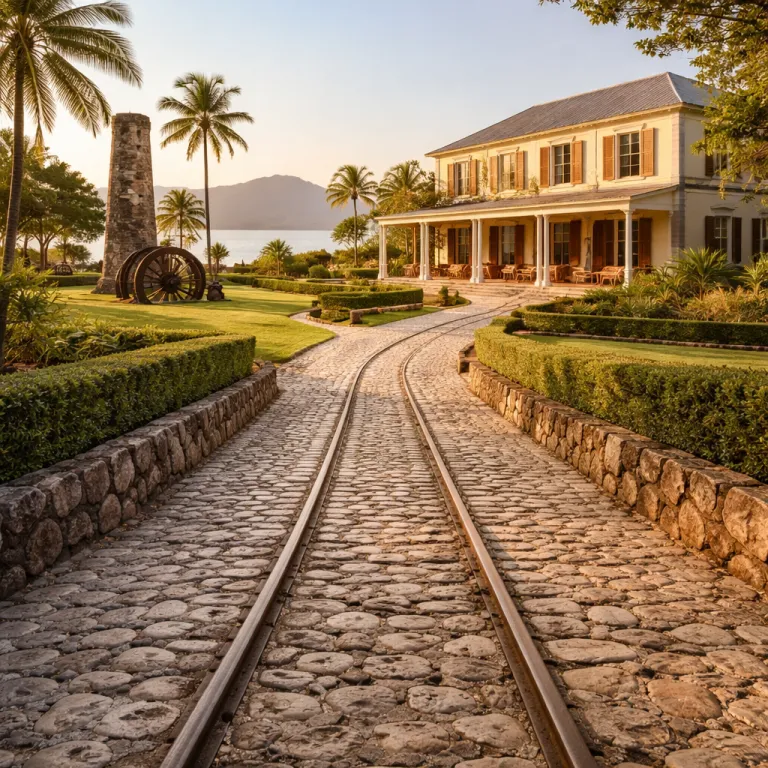
Nestled on a breezy hillside overlooking the Caribbean Sea, the restored Cane Mill House stands as a carefully preserved example of a converted sugar estate. Once part of the sprawling Richmond Sugar Works on the north coast of Saint Vincent, the property has been transformed from an industrial plantation complex into a small, character-filled boutique retreat that honors its layered past while embracing contemporary comfort.
History
The story of this converted sugar estate begins in the late eighteenth century, when British planter Thomas Haversham established Richmond Sugar Works on more than 600 acres of fertile volcanic soil. Archival records from the National Archives of Saint Vincent note that by 1802 the estate operated a wind-powered mill, boiling house, and curing house, producing raw sugar and molasses for export to Britain. Like many plantations in the region, its early prosperity was built on the labor of enslaved Africans, whose skills in cultivation, masonry, and carpentry shaped the landscape and the stone buildings that survive today.
After the abolition of slavery in the 1830s, the estate struggled to adapt to changing labor systems and fluctuating sugar prices. By the early twentieth century, the mill had fallen silent, and the great house stood largely abandoned, its coral-stone walls slowly weathering in the salt air. In 1974, architect and conservation advocate Elise Montrose purchased the derelict property with the intention of preserving its historic fabric. Her restoration work, completed in phases between 1976 and 1985, followed the principles later echoed by UNESCO guidelines: retain as much original material as possible, make new additions clearly distinguishable, and document every intervention for future generations.
Design
The design of the renovated estate balances authenticity with subtle modern interventions. The original mill tower, built from hand-cut volcanic stone, now anchors the main courtyard. Its thick circular walls, once housing grinding machinery, have been repurposed into a dramatic two-level lounge connected by a spiral staircase of reclaimed iron. The former boiling house, where copper kettles once simmered with cane juice, has been converted into the primary guest wing, with three suites opening onto a shaded veranda framed by restored brick arches.
Montrose’s approach to the adaptive reuse of this historic sugar property was deliberately restrained. Original timber beams were repaired rather than replaced, lime-based plaster was used to match the historic finish, and traditional jalousie shutters were reinstalled to encourage natural cross-ventilation. Contemporary elements—such as discreet LED lighting, low-profile ceiling fans, and polished concrete bathroom floors—were chosen to recede visually, allowing the stonework and heavy mahogany doors to remain the focal points. A small exhibition room in the old curing house displays salvaged artifacts, including iron cane knives, ledger books, and fragments of blue-and-white ceramics, accompanied by interpretive panels that acknowledge the estate’s complex social history.
Guest Experience
Staying at this reimagined sugar estate feels less like visiting a conventional hotel and more like being welcomed into a lived-in historic home. Guests arrive along a gravel drive lined with remnants of the original cane fields, now interplanted with mango, breadfruit, and frangipani. On check-in, staff offer a chilled drink infused with locally grown lemongrass and ginger, a small gesture that hints at the property’s emphasis on regional flavors and seasonal ingredients. Breakfast is served on the stone terrace overlooking the former mill yard, where the low hum of tree frogs replaces the clatter of machinery that once dominated the soundscape.
The estate’s sustainability practices are quietly integrated into the guest experience. Approximately 60 percent of the property’s electricity is generated by rooftop solar panels installed on non-historic service buildings, while a rainwater harvesting system supplies water for irrigation and laundry. According to a 2021 report by the Caribbean Hotel and Tourism Association, heritage properties that adopt such measures can reduce operating emissions by up to 30 percent without compromising visitor comfort. At Cane Mill House, these efforts translate into solar-heated showers, organic toiletries in refillable glass bottles, and garden pathways lit by low-energy fixtures. Guided walks invite visitors to explore the terraced slopes, where interpretive signs explain the original layout of the plantation, from the cane fields to the mill and the waterfront shipping point.
Practical Info
The converted estate lies about forty minutes by car from the island’s main airport, reached via a scenic coastal road that winds through fishing villages and pockets of secondary forest. The property currently offers five guest suites, each with high ceilings, four-poster beds draped in mosquito netting, and louvered windows that open to sea breezes. While the atmosphere is tranquil and intimate, the estate is not entirely remote: a small village with a grocery shop and craft stalls sits less than two kilometers away, and several beaches are accessible within a fifteen-minute drive. Guests should be prepared for uneven stone paths and occasional steep steps, a reminder of the site’s eighteenth-century origins.
Reservations are recommended at least three months in advance during the dry season, which typically runs from December to April. The estate is particularly popular with travelers interested in cultural heritage, architecture, and slow travel, as well as with couples seeking a secluded venue for small weddings. Prospective visitors should note that, in keeping with its conservation focus, the property limits air-conditioning to a few enclosed spaces and encourages natural ventilation elsewhere. This approach, combined with the use of local materials and on-site waste sorting, reflects the owner’s belief that a historic sugar estate can be both a place of remembrance and a model for low-impact hospitality in the Caribbean.